Tauri vs Electron: How Much Faster and Lighter, Really?
Electron and Tauri are the two main ways to ship a cross-platform desktop app. We dug into published benchmarks and real measurements to compare startup speed, memory usage, and bundle size — the gap is real, but smaller than the internet suggests.
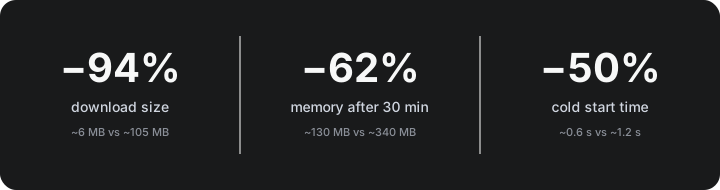
When you build a cross-platform desktop app, the first fork in the road is usually Electron vs Tauri. Everyone has heard that Tauri is "lighter and faster" — but by how much, exactly? We pulled together published benchmarks and real measurements to compare the two on startup speed and memory usage, with bundle size along for the ride.
Why the difference exists at all
Nearly every performance difference between the two comes from their architecture:
- Electron bundles Chromium and Node.js into every app. You get the same engine on every OS, but you ship an entire runtime with your app.
- Tauri uses the operating system's own WebView (WKWebView on macOS, WebView2 on Windows, WebKitGTK on Linux) with a Rust core. No bundled runtime, which is why it's dramatically smaller.
The numbers
Representative figures from public benchmarks that built the same or equivalent UI in both frameworks (mostly macOS on Apple Silicon). Numbers vary with the machine and the methodology — treat them as ballparks, not gospel.
| Metric | Electron | Tauri 2.x |
|---|---|---|
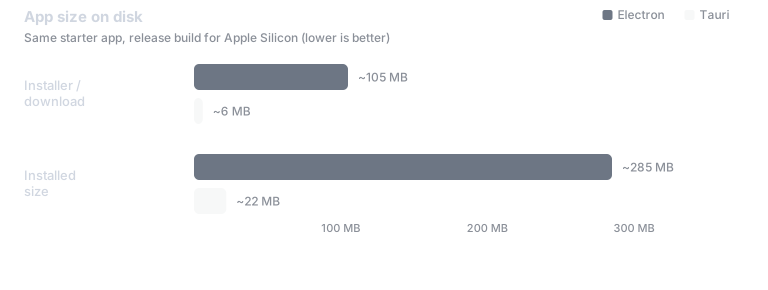
| Installer / download size | ~90-120 MB | ~2-10 MB |
| Installed app size | ~250-320 MB | ~4-60 MB |
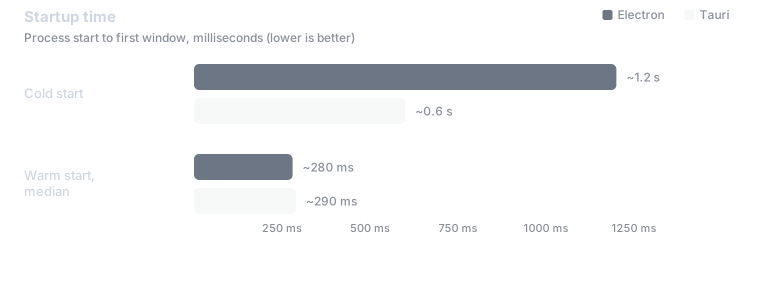
| Cold start (real hardware) | ~1.0-1.4 s | ~0.5-0.7 s |
| Warm start (median of 10) | ~250-300 ms | ~250-310 ms |
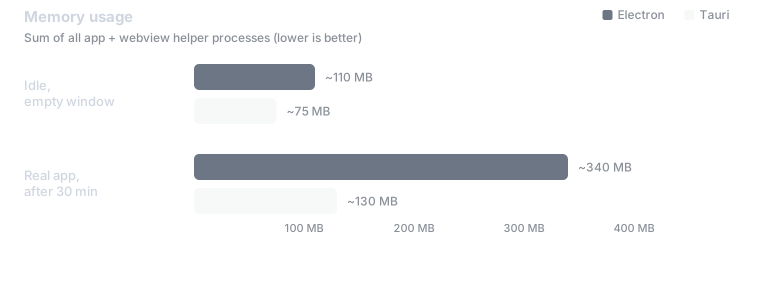
| Idle memory (empty window) | ~85-140 MB | ~45-110 MB |
| Resident memory (real app, 30 min) | ~280-400 MB | ~95-170 MB |
| First release build | ~7-16 s | ~80 s to several minutes |
Speed: a real but not crushing lead
Cold starts favor Tauri. It loads orders of magnitude fewer bytes, and first launches can be roughly twice as fast. The surprise is warm starts: on the second and subsequent launches the two are roughly on par, and some measurements actually show Electron ahead. Chromium's startup path has been optimized for over a decade, and initializing an OS webview isn't free either.
Raw JavaScript speed is an engine story. Electron runs V8; Tauri runs JavaScriptCore on macOS and V8-equivalent Chromium via WebView2 on Windows. V8 wins some microbenchmarks, but in real app UIs the difference rarely registers.
Where Tauri genuinely pulls ahead is backend work. Electron's main process is Node.js; Tauri's core is Rust. File I/O, cryptography, image processing — CPU-bound work is simply faster in Rust.
Memory: "10x lighter" is a myth
The widely quoted "Electron eats 10x the RAM" figure doesn't hold up. For small apps the gap is roughly 1.2-2.5x; under sustained use it's more like 2-3x. Real, but not an order of magnitude.
Measurement pitfalls that inflate the gap:
- Counting the wrong processes. Tauri's webview runs in separate OS helper processes (networking, GPU, media) that don't carry your app's name. Count only the main process and Tauri looks impossibly small. You have to sum all of them.
- Inconsistent state. Leaving DevTools open in Electron adds ~100 MB on its own. Compare same state, same screen.
- Your code dominates. Once the DOM and JS heap grow, your app's implementation decides memory usage far more than the framework does.
Size: Tauri, no contest
The one area with zero debate is distribution size. Without a bundled runtime, Tauri apps are an order of magnitude (sometimes two) smaller, and delta-style updates stay tiny. If download experience and update frequency matter, that's a real edge.
The honest costs of Tauri
- Windows depends on WebView2. Preinstalled on current Windows 10/11, but older environments need a bootstrapper download.
- Linux means WebKitGTK. The weakest of the three webviews for rendering performance and compatibility. If Linux is a serious target, test early.
- Three engines, not one. Safari-family, Chromium-family, and WebKitGTK each behave differently, so QA surface grows compared to Electron's "Chromium everywhere."
- Builds are slow. Rust compilation makes the first release build 5-10x slower than Electron's.
Verdict
On speed and memory alone, Tauri wins — decisively on distribution size and resident memory. But the margin is not the chasm the internet claims, and startup speed can be a wash depending on conditions.
The practical framing: choose Tauri if footprint, download size, and backend performance top your list; choose Electron for its ecosystem, guaranteed browser consistency, and faster build loop. And if you're on Electron already, disciplined app-level work keeps it comfortably within what real users will tolerate.
Sources
Build from the docs
Install, configure, and harden Arg0 with the same reading layout.